Download the IMAAVY brochure
Your all-in-one guide to IMAAVY clinical study results, safety, dosing, and more
Download

Your all-in-one guide to IMAAVY clinical study results, safety, dosing, and more
Download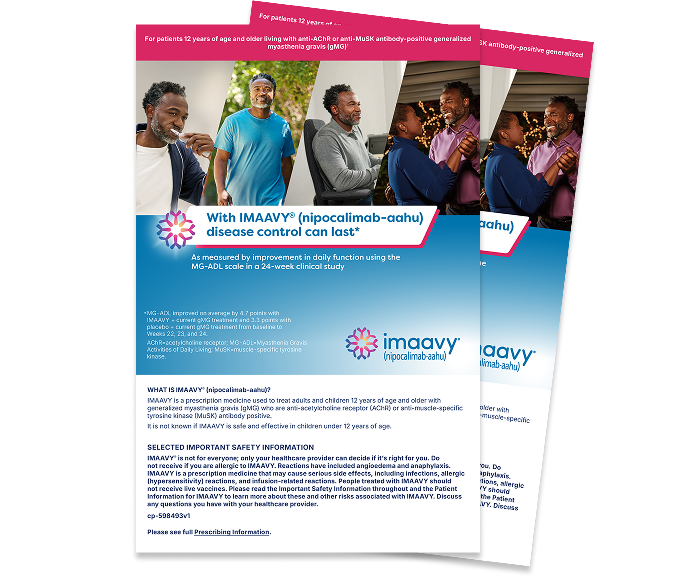

Watch the video and speak to your healthcare provider today.

Hear about the treatment experiences of Allison, a patient on IMAAVY.

Hear about the treatment experiences of Ellen, a patient on IMAAVY.

Register for our webinar series and learn more about IMAAVY from our clinical educator experts. Ready to sign up?
Sign up nowWatch the video and speak to your healthcare provider today.

Learn about the IMAAVY withMe Savings Program and how it can help eligible patients save on out-of-pocket treatment costs.
Download
Read about how IMAAVY withMe can help you find cost support options, regardless of your insurance type.
Download
Follow these tips to help you care for yourself so that you can be a better caregiver for someone else.
DownloadThe support and resources provided by IMAAVY withMe are not intended to provide medical advice, replace a treatment plan you receive from your healthcare provider or nurse, or serve as a reason for you to start or stay on treatment.
Find an infusion center
Use this tool to look up infusion centers near you that may carry IMAAVY. This can help you and your healthcare provider plan for where you’ll receive your IMAAVY infusions.
Commonly asked questions about IMAAVY
You may be eligible for IMAAVY if you are 12 years of age and older and have generalized myasthenia gravis (gMG) that is antibody-positive (anti-acetylcholine receptor [AChR] or anti-muscle-specific tyrosine kinase [MuSK]). Talk to your healthcare provider to find out if IMAAVY is the right choice for you.
*It is not known if IMAAVY is safe and effective in children under 12 years of age.
As a neonatal fragment crystallizable receptor (FcRn) blocker, IMAAVY binds to FcRn to help reduce the amount of circulating immunoglobulin G (IgG) antibodies, including harmful anti-AChR and anti-MuSK antibodies, in your body.
Based on research from laboratory and/or clinical studies. The clinical significance of these findings is unknown.
Your healthcare provider should monitor you for reactions to IMAAVY during the infusion and for 30 minutes after each infusion. If you have a reaction during your IMAAVY infusion, your healthcare provider may infuse IMAAVY more slowly, or give you medicine before your infusion, or stop your infusion if your reaction is severe.
If you miss a scheduled IMAAVY infusion, you should receive your next dose as soon as possible.
IMAAVY will be given to you by your healthcare provider through intravenous (IV) infusion into your vein.
The most common side effects in people with gMG treated with IMAAVY include:
If you have a reaction during your IMAAVY infusion, your healthcare provider may infuse IMAAVY more slowly, or give you medicine before your infusion, or stop your infusion if your reaction is severe.
IMAAVY can cause serious side effects, including:
These are not all of the possible side effects of IMAAVY. Call your doctor for medical advice about side effects. You are encouraged to report negative side effects of prescription drugs to the FDA. Visit www.fda.gov/
Glossary
Autoimmune: Refers to a category of conditions in which the immune system mistakenly attacks the body's own organs or tissues. Myasthenia gravis (MG) is considered an autoimmune disease.
Clinical study: A research study conducted by investigators to determine the effectiveness and safety of a treatment like IMAAVY. The U.S. Food and Drug Administration, or FDA, reviews clinical trial data to determine if an investigational treatment is safe and effective to be approved for use.
FcRn (neonatal fragment crystallizable receptor) blocker: A class of medications that IMAAVY belongs to. FcRn blockers bind to FcRn, a protein in your body, to help reduce the levels of IgG antibodies, including harmful IgG antibodies.
Food and Drug Administration (FDA): A government agency responsible for protecting the public health by assuring the safety, efficacy, and security of human and veterinary drugs, biological products, medical devices, and the safety of our nation's food supply, cosmetics, and products that emit radiation.
Generalized myasthenia gravis (gMG): The most common form of MG, a rare autoimmune neuromuscular disease that interrupts the communication between the nerves and muscles, causing muscle weakness and tiredness.
Harmful immunoglobulin G (IgG) antibodies: Also known as autoantibodies, they are a type of antibody that attacks the body's own tissues and organs, leading to symptoms such as those seen in autoimmune disorders like gMG. In gMG, these harmful IgG antibodies can include harmful anti-AChR and anti-MuSK antibodies.
Immunoglobulin G (IgG): A type of antibody and the most common type found in the body. They are produced by the immune system to help protect the body from infection and disease.
Intravenous (IV) infusion: A process that delivers fluids or medication directly to the bloodstream through a vein. IMAAVY is given as an IV infusion by your healthcare provider or trained infusion specialist.
Myasthenia gravis (MG): A rare, chronic autoimmune condition that disrupts communication between muscles and nerves.
Neonatal fragment crystallizable receptor (FcRn): A protein that helps regulate the amount of immunoglobulin G (IgG) antibodies circulating through your body. FcRn blockers like IMAAVY bind to this protein in order to help reduce IgG antibody levels.
Neuromuscular junction: A region in your body where the nerves and muscles meet, allowing for signals to be sent between them. MG affects the neuromuscular junction's ability to send these signals.
Receptors: In generalized myasthenia gravis (gMG), receptors refer to proteins at the neuromuscular junction (such as acetylcholine receptor [AChR] and muscle-specific tyrosine kinase [MuSK]) that help nerves communicate with muscles.

Myasthenia Gravis Foundation of America (MGFA)
The largest and leading MG advocacy organization in the United States. They are dedicated to finding a cure for MG while improving the lives of people living with it.


MGFA - MG Lexicon
Produced in collaboration with patients, medical professionals, and industry partners, this lexicon guide bridges the gap in terminology between healthcare providers and those affected by MG.


Once you and your healthcare provider have decided that IMAAVY is
right for you, IMAAVY withMe is here for you and your loved ones with
free personalized support when and where you may need it.
Not ready to sign up yet?