For US Patients
Prescribing Information
IMAAVY® (nipocalimab-aahu)
Log InSign Up For Support

Living with warm autoimmune hemolytic anemia (wAIHA)

What is
wAIHA
?

wAIHA is a rare disease.
It happens to ~1 in 8000 people. Anyone can get wAIHA, but it’s often diagnosed in adults between the ages of 50 and 70 years.

wAIHA stands for warm autoimmune hemolytic anemia. Let's break it down word by word.

Warm

Harmful immunoglobulin G (IgG) antibodies
bind to and attack red blood cells at normal body temperature (98.6 °F).

Autoimmune

The immune system gets confused and attacks itself.

Hemolytic

Red blood cells get broken down and destroyed.

Hemoglobin
levels drop and may be below 10 g/dL. Normal levels vary but are generally between 12–17 g/dL.

Anemia

There are not enough healthy

red blood cells
to carry oxygen throughout the body.

Be wAIHA wise!

An attack on your red blood cells affects your hemoglobin. Hemoglobin is the part that carries oxygen. Levels below 10 g/dL may signal a need for treatment.

What's happening in your body

In wAIHA, your immune system mistakenly creates harmful

IgG
antibodies that target your red blood cells. This traps you in an ongoing cycle that can lead to symptoms like fatigue (extreme tiredness).

With wAIHA, your immune system gets confused

Your immune system gets confused

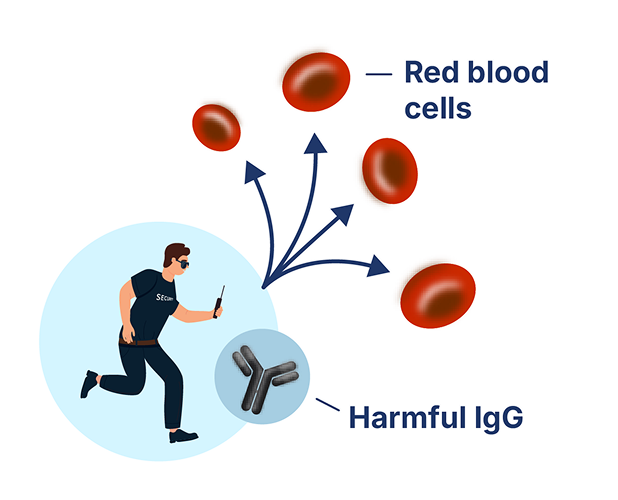
Your immune system protects you from invaders, like germs. Think of it as a bodyguard. But with wAIHA, the bodyguard gets confused. It starts creating harmful IgG antibodies, or attackers, that attach to your red blood cells.
Diagram of harmful IgG antibodies mistakenly tagging your red blood cells as bad

The attackers mistake the good guys for the enemy

The harmful IgG antibodies mistakenly identify and tag your red blood cells as the bad guys.
Learn about how FcRn keeps IgG around longer here
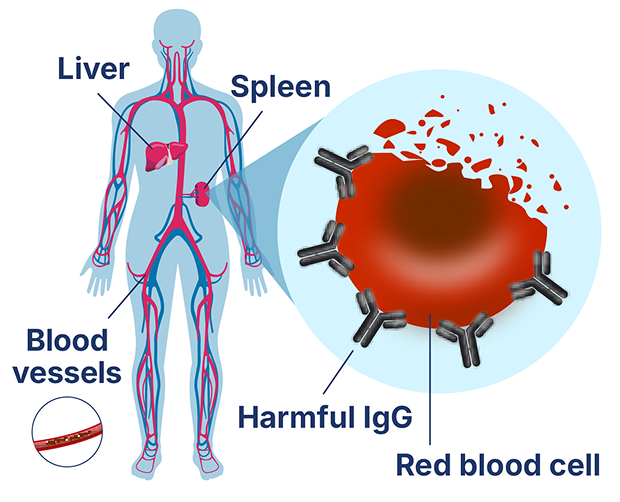
Diagram of red blood cells being broken down in the spleen

Your red blood cells are then destroyed mainly in the
spleen

Your red blood cells are sent to an organ called the spleen, where they are broken down. This leaves you with fewer red blood cells to carry oxygen.
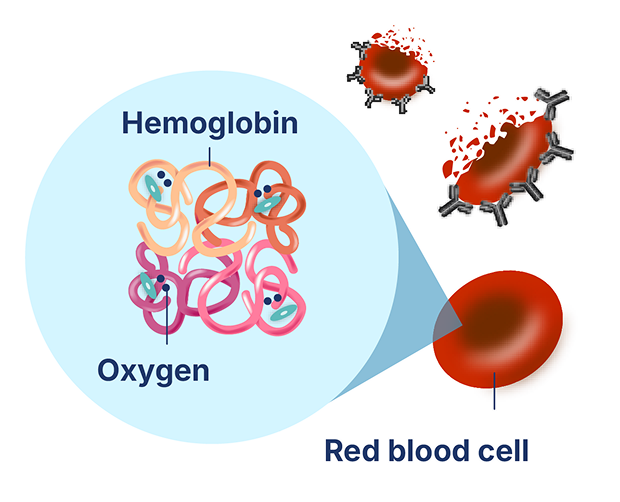
Diagram of when wAIHA symptoms appear

Symptoms of wAIHA appear

Hemoglobin levels then drop, which is the part of your red blood cell that carries oxygen to your body. This is why you may feel so tired or worn out (fatigue). Other symptoms may include dizziness, pale
skin, and shortness of breath.

Be wAIHA wise!

wAIHA is different from iron-deficiency anemia. Vitamins and diet can't fix it. Your body may need a medicine that targets your immune system. Talk to your healthcare provider about what may work for you.

Common symptoms of warm autoimmune hemolytic anemia (wAIHA)

Not everyone with wAIHA has the same symptoms, and they can come and go. But for many people, low hemoglobin levels can cause some symptoms including, but not
limited to:

  • Fatigue

  • Weakness

  • Dizziness

  • Pale skin

  • Shortness of breath

  • Heart palpitations

More about
fatigue

Fatigue is not the same as tired
  • Fatigue is more than just being tired. It can feel a little different for everyone, too. Your body may feel physically drained
There are ways to manage it
  • Your healthcare provider can recommend ways to manage fatigue. This may include certain suggestions for your lifestyle
Keep track and share
  • Consider discussing your symptoms, including fatigue, with your healthcare provider to help determine the right goals for managing your condition
  • It may be helpful to write down or add notes to your phone to share at your next visit
IMAAVY® (nipocalimab-aahu) Transparent Logo leftIMAAVY® (nipocalimab-aahu) Transparent Logo left

Get personalized support tailored
to your unique needs

Once you and your healthcare provider have decided that IMAAVY is right for you, IMAAVY withMe is here for you and your loved ones with free personalized support when and where you may need it.

Sign up for support

Not ready to sign up yet?

Learn more now

IMAAVY® (nipocalimab-aahu) Transparent Logo right